Week 3 Reflection – Learning About AI
This week we talked about AI – a hot topic in the world these days, especially in teacher’s college. It seems to be the way things are going, and more and more people are using AI to create lesson plans, rubrics, assessment tools, etc. It seems like a great use of technology, but is it all sunshine and rainbows?
Learning the risks and benefits of AI
I think, with anything, its important to weigh the pros and cons of something before diving head first. AI is a buzzword that seems to be everywhere. And honestly, it causes me a lot of stress thinking about it, especially after this week’s discussion. My pre-existing knowledge of AI is that it has a large negative impact on the environment (as it stands currently), has caused harm to many people and children, and can reduce overall creativity and the opportunity to learn. I am hesitant to use AI, and think just because its the new big thing doesn’t mean we should delve in right away. I want students to learn the skills to critically think for themselves, analyze texts, and compile information without AI doing it for them. I wish it wasn’t so harmful to the environment, and that there were more safeguards in place to protect children and adults from online violence and misleading information. I am sure all of these things are to come, but we are living through the beginning stages of this technology that comes with a learning curve for everyone. I think we cannot talk about the benefits of AI without warning of all the risks and negatives that come along with it.
AI in Education
I do think there is a place for AI in education, as it is a very powerful tool that can save a lot of educators a lot of time. However, I don’t think it should be relied on fully by anyone. Too much of a good thing is almost always harmful. I understand the position that it is our job as future educators to teach students how to properly use AI, just like any other form of technology. It makes me wonder: at what age do you start incorporating this into your lessons? Should AI become part of education as soon as students start using computers? I think that there is a responsibility that adults have to set up students for success and let them lead with their best foot forward. To me, this means teaching the fundamental skills first, even though AI can do them quicker. I don’t know how important it is for young elementary students to use AI. As a teacher, AI could save you a lot of time with lesson planning, marking, assessment, and compiling information. I still think it is beneficial to know how to do these things without AI, but then use it sparingly when needed.
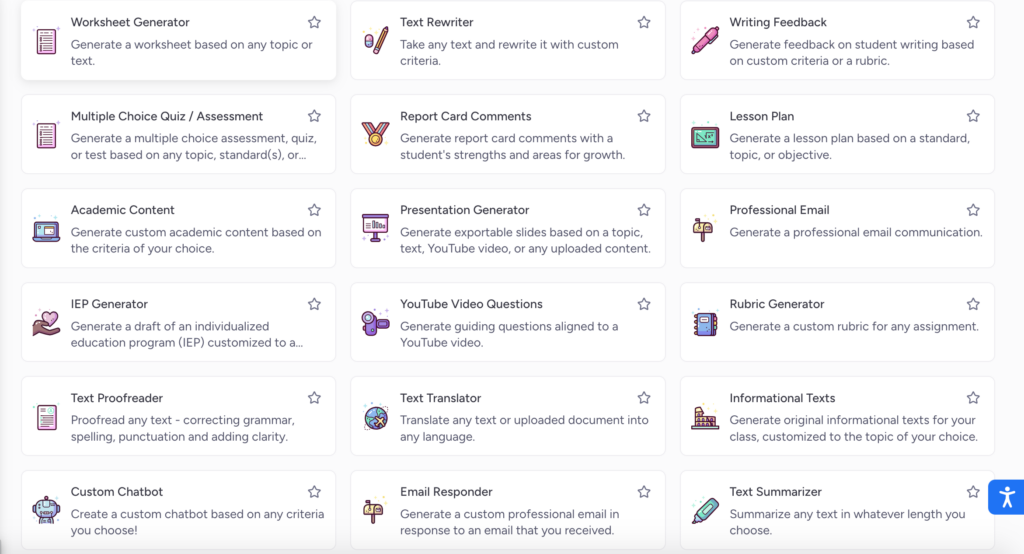
Basically, do the benefits outweigh the cost? Sometimes, yes. But that doesn’t mean I’m going to use AI at every opportunity I have. Below is the AI platform MagicSchool, that I used for my AI workbook assignment. This is just the first page of options for AI help, and it goes on for many more after this. It is quite incredible how many resources are available to us (humans) now.
I think the fact that our society is so obsessed with productivity, efficiency, and progress really plays in to the use of generative AI. We are always looking for a quicker way to do things. I understand how helpful time saving resources can be, especially in a job as time consuming as teaching. However, I don’t want to lose the perspective that putting some time into creating something (a lesson plan, a unit, a test, an activity) is not a bad thing. I am worried that generative AI will squander this ability in teachers and future educators, because it is so tempting to use a tool that will create something for you in seconds. As I move through my educator journey, I want to continue to ask myself if what I am doing aligns with my morals, and if the benefits outweigh the negatives. If we (society) decide to use something that is causing harm to the environment and other people just for the sake of efficiency, is that a worthy reason? I don’t know the answers to how much is too much, or what the price is exactly. But I do want to keep asking these questions and reflecting as I learn more through life and experiences.
Here are some resources I found helpful when reflecting on this conversation.
Understanding GenAI through Indigenous ways of knowing
A social-environmental impact perspective of generative artificial intelligence
Astrid, some good reflections! You ask questions that are about balance, ethics, and the environment. I agree, we need to teach students how to use AI properly. However, we have to follow our school’s and district’s lead there. I am not sure at what age is proper, but I do know that my late teen grandchildren do not use GenAI for fear of being accused of doing so and penalized.
I like your comment: “I think the fact that our society is so obsessed with productivity, efficiency, and progress really plays into the use of generative AI”. I never thought that way about it. What I do know is that it is idealistic to think that if AI makes teachers more efficient, it will improve teachers’ ability to focus on individual students. We will likely just get more students…